

I feel as though there would be something amiss if I didn't take the opportunity to compare, once again, America and the United States.
I left for Boston the 2nd of June. It was late. With my large army surplus knapsack and small laptop carry-on, aided by my friend Kara, I slowly hoisted myself from the zemidjian and onto the broken sidewalk. My stomach was twitching nervously as I gazed at the large, formerly unfamiliar building in front of me. Kara walked me right to the line to check in and hugged me good-bye.
"Enjoy America," she said.
"I will," I replied robotically, my eyes shifting around to make sure my luggage was safe in front and behind me. Then she disappeared, I saw her blond hair and white arms for just a moment before she shattered into a million pieces and I was on the plane.
The man next to me was a Sergeant with the US Military. I didn't want to talk with him at first. I thought he would try to hit on me. I had been conditioned to not talk to men unless I had to. It's just easier to ignore them outright instead of engaging them and finding it necessary to do so later when they start harassing you to give them your phone number. He was nice. He had a blond mustache. He thought my Nagot was endearing. He was training Beninese soldiers near the Nigerian border. He uniform faded into the gray of his airline seat as I dozed off.
The food. So much food. Every time I awoke, Air France fed me. Dinner, breakfast, lunch and a snack. Real butter. Cheese. Bread. I couldn't touch the wine, worried it would be too rich. Clean, cold water was a blessing in a plastic cup. On the plane ride to Benin the first time, my friends Rich, Bradley and I all got drunk on the complimentary airline size bottles of wine. We were raucous and giddy with red mouths and teeth. I drank because I knew I wouldn't be able to sleep on the red eye flight, never having had to get used to sleeping sitting up. This flight I couldn't keep my eyes open. I didn't have time to watch an in-flight movie or listen to music or read. I just slept, lulled by the peaceful ride and vibration and relative infrequent bump in the road.
At Charles de Gualle I stared in wonder at the series of automatic revolving doors. Thinking about how revolving doors were so efficient. I drank a cup of coffee and listened to my Ipod for six hours, marching up and down the terminal trying to see what I would like to buy. The New York Times was sold out, I settled for the Herald Tribune. I watched lovers entwine their legs beneath cafe tables and harried parents usher small children past men in wrinkled suits with sunglasses. I tried to write. Nothing came out. I was tapped out. Dry. My brain was overloaded in the way that it was when I first arrived in Benin. Culture shock. I didn't want to talk to anyone. I didn't want anyone to know who I was or where I was coming from or where I was going. I was anonymous, the way many Americans like to be.
Arriving in Boston I was elated to see David. A pair of cow horns strapped to the top of my knapsack made it difficult to walk, they were almost twice as wide as my body and tied near my neck. People stopped and stared from their cars as we walked to his apartment. I felt as though I looked like a minotaur. I spent two days delirious. When I closed my eyes I'd see JoJo running through the bush, naked, as usual. I'd see my mama walking back and forth from the the house with a pan of water to wash dishes. I'd see Mouda scrubbing laundry beneath the mango tree. Red dust. Roosters. The constant sound of women pounding meager tubers into food. The call to prayer. Then I'd open my eyes and see cars, skyscrapers, white people, glass windows, asian people, curtains, brown people, soft beds, food. So much food. So, so much food.
Finally when my brain caught up with the rest of my body and realized where I was, it was time for all of that good food to make me sick. At a very nice Indian restaurant in Porter Square I suddenly realized I couldn't eat all of those saturated fats and sugars anymore. Perhaps it was a virus or food poisoning- or perhaps I just wasn't used to the way I used to eat. In the United States, food and restaurants serve as forms of entertainment. Eating is a leisure activity, typically served quickly and enjoyed with friends or family in a way that seems more foreign than ever now. Americans don't break bread over the same dinner table as their parents, they're sharing naan at trendy establishments with tall cafe tables and wifi. I can't tell you how many lunches served as 'visits' over the following two weeks.
The next two and a half weeks were a whirlwind of faces, similar questions, toasts, and travel. I saw my family for nearly a week and a half, successfully visiting with all of my sisters, friends from high-school, college and gave a small presentation to my sister Bek's 1st grade classroom. I realized dressed in "traditional garb" (A bunch of panges I wrapped around myself because I didn't think to bring any modeles), and speaking in front of a class of students that I was conditioned to speak with an African accent, my voice slow and consonants softened. I had found my teacher voice, and it was from West Africa. I danced the "chicken" dance, a kind of difficult and awkward dance, in a bar in Albany. I fell asleep into my chinese food in Queens after talking about buruli ulcers. I walked through Prospect Park thinking about sacred forests and urbanization. I complained that my friends walked too fast, were too scheduled, that the subways felt like slave ships. There was no time to sit. I couldn't write, I had barely enough time to sleep. I thought back to my days at the New York State Senate and college, how if I had just one day in two weeks were I didn't have plans it was a blessing. If I could finish a newspaper I didn't have enough to do. I began to see Benin as a bit of a haven, where my time was freer, the faces friendlier, and the work rewarding.
Frequently Asked Questions:
So how was Africa?
-- It was/is fine(?)
What do you eat out there?
-- Uh, grits beaten with a stick until starchy. Sauce made from fish and tomatoes.
What else?
-- ? Whatever I can find.
What is the most messed up/ scary thing you've seen?
-- Why would you want to know the answer to that question?
How do you go to the bathroom?
-- I have a latrine.
So no running water, huh? Wow. How about electricity?
-- Yes, but it does go out sometimes. I'm lucky to have it though.
When do you come back?
-- I don't know. Probably September 2011.
Why not sooner?
-- I don't know. I can't make plans that far in advance. On verras.
I met Chris Kotfilia, a friend who also served in Peace Corps Benin, in the same coffee shop where we used to work together. He asked me what kind of Volunteer I became. I instead just listed every kind of volunteer one could be before deciding that I had no idea. I don't have the luxury of categorizing myself and my work in that way. He told me about how he goes to Chinese markets to try to find West Africans. How he now mentors a middle schooler whose family is from Savalou. We talked about how we didn't want Benin to be 'It', the one cool thing you do in your life; the one accomplishment that you always draw on for your world perspective. He's thinking of traveling, but is juggling first world responsibilities such as degrees and long term relationships. I felt relieved to not be wearing the same cement shoes, even if my feet are tainted red.
After another six days with David, I left for Paris. I said to him as I was packing that I was worried I'd be crying into my complimentary wine hovering over the Cotonou airport. However, the plane was comfortable, even though they fed me too much again. Instead of crying on the final descent, I felt relieved. Benin was going to be my home for the next year, and it felt good to be home.
Sunday, July 25, 2010

Sunday, May 30, 2010
Small Victories in the Bush
Yesterday I made a point of being difficult as possible as I was packed into the backseat of a taxi tottering back from Djougou. As the driver slammed shut the door I protested, "Chaffeur, this car here, it's a five place. Not a nine place. Now with nine people there, this is dangerous." He shrugged and offered the common response to any foreign complaint, "This is Africa." I didn't let him off that easy. "It is not Africa. It's Benin. You think that in Ghana and Nigeria the chaffeurs put the people in the taxis like this? Absolutely not. It's not like this in all of Africa. It's only like this in Benin. Because the chaffeurs want to eat money. They are bandits. They bouf." (Bouf means to be gluttonous, it can be used for food or for money- it's especially used for bribes) I shoved my hand to my mouth to make my point.
A chorus of voices rang out in agreement, complaining that they shouldn't have to be made to sit like spoons in a drawer. Especially, as one woman pointed out, the old mamas in the backseat, hunched over, their tiny backs spindled awkwardly as they rested against the seat in front of them. "It's us who give you money, chaffeur. It is not you who must decide if there is a place for another person. We are the boss. Not you." The chaffeur started explaining that he doesn't make a lot of money, that with the price of gas and the "taxes" (bribes) he must pay, he only makes five mille (ten dollars) to go from Djougou to Bassila. I was outraged that he would dare to tell me that wasn't enough money. That's more money than even I make. I have to pay him three dollars, an entire day's wage, to go from Djougou to Bassila, typically sharing my seat in the front with some stranger, the stickshift awkwardly beneath me, and stop in every small village- sweating in the hot sun. I don't know why, but I couldn't just leave him alone.
I told him that every day there are buses that go from Cotonou to Nati, and that they are less expensive. That in a bus, you have your own place and you don't need to share your seat. That one day, there will be no taxis because there will be enough buses and everyone will know that the bus is better than a taxi because the driver isn't greedy.
The little mama next to me began whimpering a little, which infuriated me further. My legs cramping, I stood up, with half of my body out the window, and sat on the door. My legs and waist rested firmly in the car. I motioned to the mama to rest back against the seat where my back had been. It was far more comfortable up there on the door, my body out the window. The taxi was an old Peugeout, and sputtered at about 35-40 mph. It didn't feel dangerous. The chaffeur started yelling at me, telling me to get back in the car. I refused. The mama looked worried but smiled at me, perhaps grateful for the opportunity to rest.
And so I stayed there. Big trucks rolled by, the men on top of them yelling out, "Heyyyy Batouri!" I hummed quietly to myself and stared at people staring at me. I thought about grabbing my moto helmet and wondering if this was at all against Peace Corps regulations. At the next petit village one of the marche mamas who shared the three place backseat with the other seven people, including two children relegated to laps, got out and began unloading her chickens and cement sacks from the back of the taxi. The chaffuer got out of the car and stared down at me. I met his eyes and didn't dare blink. He told me to get back in the car. I told him I would only get back in the car if he promised not to put anyone else in the back seat. That five people was too many. Four people and two children were enough. He stared at me a moment, then shook his head and sighed, "Batouri...". I shrugged. I was pretty happy sitting up there, and it didn't matter to me if he kicked me out of the taxi entirely- which I knew he wouldn't do because he wanted my money. "On y va?" I asked. "Yes, let's go." I got back in the car, my face a slightly different color than the rest of my body from the dust. The ladies in the back seat looked satisfied, but I knew they were thinking I was absolutely crazy.
And to a degree, I was a little crazy. It's absolutely acceptable and common practice to put nine people in a five person car. Four up front, five in the back. Somedays though, I don't want to deal with it. It wasn't even so much about my comfort, although that had something to do with it, but the fact that this little old lady was visibly in pain by the way we were crammed in together. It was the idea that the passenger is at the mercy of the driver. It was that we were women and relegated to the back of the bus, as it were. I don't usually take it upon myself to yell at Beniniese people and argue with them, because I know that it won't make any discernible difference. However, sometimes you just want to pick a fight. I chose that taxi driver as my opponent.
And I won.
A chorus of voices rang out in agreement, complaining that they shouldn't have to be made to sit like spoons in a drawer. Especially, as one woman pointed out, the old mamas in the backseat, hunched over, their tiny backs spindled awkwardly as they rested against the seat in front of them. "It's us who give you money, chaffeur. It is not you who must decide if there is a place for another person. We are the boss. Not you." The chaffeur started explaining that he doesn't make a lot of money, that with the price of gas and the "taxes" (bribes) he must pay, he only makes five mille (ten dollars) to go from Djougou to Bassila. I was outraged that he would dare to tell me that wasn't enough money. That's more money than even I make. I have to pay him three dollars, an entire day's wage, to go from Djougou to Bassila, typically sharing my seat in the front with some stranger, the stickshift awkwardly beneath me, and stop in every small village- sweating in the hot sun. I don't know why, but I couldn't just leave him alone.
I told him that every day there are buses that go from Cotonou to Nati, and that they are less expensive. That in a bus, you have your own place and you don't need to share your seat. That one day, there will be no taxis because there will be enough buses and everyone will know that the bus is better than a taxi because the driver isn't greedy.
The little mama next to me began whimpering a little, which infuriated me further. My legs cramping, I stood up, with half of my body out the window, and sat on the door. My legs and waist rested firmly in the car. I motioned to the mama to rest back against the seat where my back had been. It was far more comfortable up there on the door, my body out the window. The taxi was an old Peugeout, and sputtered at about 35-40 mph. It didn't feel dangerous. The chaffeur started yelling at me, telling me to get back in the car. I refused. The mama looked worried but smiled at me, perhaps grateful for the opportunity to rest.
And so I stayed there. Big trucks rolled by, the men on top of them yelling out, "Heyyyy Batouri!" I hummed quietly to myself and stared at people staring at me. I thought about grabbing my moto helmet and wondering if this was at all against Peace Corps regulations. At the next petit village one of the marche mamas who shared the three place backseat with the other seven people, including two children relegated to laps, got out and began unloading her chickens and cement sacks from the back of the taxi. The chaffuer got out of the car and stared down at me. I met his eyes and didn't dare blink. He told me to get back in the car. I told him I would only get back in the car if he promised not to put anyone else in the back seat. That five people was too many. Four people and two children were enough. He stared at me a moment, then shook his head and sighed, "Batouri...". I shrugged. I was pretty happy sitting up there, and it didn't matter to me if he kicked me out of the taxi entirely- which I knew he wouldn't do because he wanted my money. "On y va?" I asked. "Yes, let's go." I got back in the car, my face a slightly different color than the rest of my body from the dust. The ladies in the back seat looked satisfied, but I knew they were thinking I was absolutely crazy.
And to a degree, I was a little crazy. It's absolutely acceptable and common practice to put nine people in a five person car. Four up front, five in the back. Somedays though, I don't want to deal with it. It wasn't even so much about my comfort, although that had something to do with it, but the fact that this little old lady was visibly in pain by the way we were crammed in together. It was the idea that the passenger is at the mercy of the driver. It was that we were women and relegated to the back of the bus, as it were. I don't usually take it upon myself to yell at Beniniese people and argue with them, because I know that it won't make any discernible difference. However, sometimes you just want to pick a fight. I chose that taxi driver as my opponent.
And I won.
Thursday, May 20, 2010
Waiting for the Man
The first set of devoirs are finished, leaving me with approximately 200 papers to grade this weekend. I was hoping that since the material was something we had covered in great detail, and that I held a review session immediately before the exam, they would do fairly well. Unfortunately that was not the case. Not that they did especially terrible, but I am still coming to grips with lowering my expectations.
I am traveling again for most of June, a trip I am incredibly excited for. To do this, I will have to grade another set of 200 quizzes and devoirs. My Director was very compassionate and kind to allow me to finish the school year early, aided by the fact that I was one of very few teachers (Hafissou and Narcissis included) who continued to teach during the strike. Not that I had a choice, I am an apolitical employee and not paid by the state, therefore I have no recourse and could not participate in the strike even if I had wanted to. I guess I am using this opportunity to procrastinate my grading for just a few minutes, until it is time to sit down with the red pen and grade books.
In Cotonou, my dear friend Bradley Mock and I were out at a bar known as "Sunset", which rests right on the beach, overlooking the oil tankers trudging back from pillaging the Niger Delta. The sun was setting over the water in the West. It was cool and the waves were heading out to sea. A group of young men and women were pulling these enormous, heavy nets to shore. They were singing. We watched for awhile, lost in the fantastic reality of their lives. It was then that Bradley stood up, finished his Beninoise and said, "I'm going to go out there." Grinning and sipping my own beer, I told him he probably had to.
He came back forty-five minutes later, sweating and elated. He told us that when he went out there they were calling to him, "Yovo!" Brad's post is in a Mahi village, and so he speaks decent Fon. He told them, "There is no yovo here, I'm Fofo." (meaning "brother") As he picked up the net to help pull in the fish, against the current, the young men started chanting "Yovo... yovo... yovo..." As he stayed and continued to work, the chant changed. It was only a matter of time, with the rhythm of their pulls, that they began to chant "Fofo... Fofo... Fofo..." When the fish were in, tangled in garbage and tangled netting, they offered him some. He politely declined. There wouldn't be much use for the fish back at the bureau. I feel a bit strange telling Bradley's story for him, he has his own blog somewhere in the Peace Corps Blogosphere. I only hope he takes the time to tell his own version.
Right now I am baking brownies to give to Narcissis, Okounde and Mama's family. It has taken me awhile to get used to the idea of sharing food in the way that I am encouraged to. A Volunteer was telling me that in her village a popular phrase is, "If there's enough for one, there's enough for two." The numbers are interchangeable depending on how many people are sharing the meal, "if there's enough for three, there's enough for four," and so on. Last week, I was talking to a very drunken man in my village who was describing, in broken French and Nagot, about Fou-fou, or manioc, and some kind of sauce I am not familiar with. He smiled with a far away look in his eyes. "That is the kind of meal that would make you full." It was a startling realization for me that very few people have the resources available to them to eat until they are satisfied. Yet they are constantly offering food to share. While I may still guard my precious tuna fish and other goodies sent from the United States, I do see it as part of my responsibility to share what I feel I can share. My sister sent me some protein powder that I mixed with powdered milk and honey that I gave to Luc and Gi until it ran out. Once, while resting with me in my home, Mouda asked me about an apple that was sitting in my basket. It took a long time to convince him that "pomme" was not "pomme de terre", a potato. He had never had an apple before. When I gave it to him, he was so happy. "Please," he said, "the next time you travel, could you bring me back another one?" I was happy to oblige.
There aren't enough nutritious foods here. Not enough vegetables or fruits, even for someone who is supplementing their African diet with Western goods. The ones that are available are expensive. Yet, I find that the more I give, the more I receive in return. Coming home from Natitingou this weekend, I opened my fridge to see a small wheel of wagasi, the Fulani cheese, wrapped in aluminum foil. A gift from Luc. Edwidge, the pastor's wife who lives behind my concession, brings me tomatoes and little bits of corn when she can. My mama is always asking if I've already made food for myself, inviting me to eat with them. I typically decline the offer, as I prefer my spanish rice to her really greasy, kind of gross, food. However, the sentiment is... heart-warming. I do not cook here because I have to, but because I want to. There are more than enough people who care about me that would take care of me if I needed it. I'm slowly learning about living in a communal society. It's people to share food with, to cook with, to ask advice and laugh with. When bad things happen, they're the people that shake their heads solemnly and click in the back of their throats. When someone dies it is the entire village who mourns, and if the person was old enough, celebrates.
I was complaining to my mother the other day about the stress of living in a concession where everyone feels as though they are part of your family. I do not live in a house, per say, but in very large room in a very large home. If I am not up and my doors are not open by 9am, it is my Mama who comes by the house asking if I am sleeping or sick. If my doors are open past 10pm, it is Papa or Narcissis who will call to me to close my door and go to bed. All day I receive visitors from different places in my village. The children in my concession, other teachers, Edwidge, my neighbors, Papa, they all come by to saluter me and ask if I've slept well, if I am going to cook food, what I am doing for the day. Sometimes it's really frustrating when I think back on my life in Albany, when if someone wanted to come visit me they would call my cell phone before coming over. I could rest in my house all day and do work without interruption. I could lie around naked and socialize via instant messaging or email without leaving my room. I miss that independence, to make decisions for myself regarding where I was going and what I was doing. My Mama will absolutely not accept me coming home from Basilla at night, even though I have no reason to believe it is dangerous. She doesn't want anything bad to happen to me, but at 23 years old, I really believe it is my decision. Still, the few times I have done so, because I had school in the morning or just needed to come home, I was apologizing. "Ne pas fâche, eh Mama?" Don't be mad Mama. Your daughter is a grown woman. She needs to be able to do things for herself.
Speaking of daughters, Mama's third oldest daughter, Rafiatou, is pregnant. She is seventeen years old. I have not had the audacity to ask about the father, and I assume someone will eventually tell me. She is no longer in school and spends her days beneath the mango tree, resting on a mat. I don't feel responsible, per say, but the situation does make me think about how the importance of sex education. Rafia is not in my Girls' Club, as it was a selective process. I wonder if the experience of being in those conversations with the Sage Femme about pregnancy, sexual health and female empowerment would have made any difference. It's a moot point, I know, but it's a sad realization that Rafia will probably not finish her schooling now. On a more positive note, I am excited to meet this baby once it comes into the world. (She says she thinks it's a girl, but we'll find out come November)
Back, a long time ago, I used to go to Christian Sunday School. It wasn't that my parents were especially religious, but the United States being a predominately Christian nation they felt it was important for me to gain a good understanding of the Bible. Every Christmas, after the mandatory Christmas Story Pageant, there would be an "Operation Christmas Child" drive, where we would fill shoeboxes full of small toys and candies to be sent overseas to children who would undoubtedly never have seen a Christmas with presents. I know that someone, somewhere, would add little brochures about Jesus and salvation and all that, so children would understand who was sending them these gifts (and why).
I think I would like to do something similar, but perhaps without the Christian overtones. There are a lot of little girls here who ask me if I can help them get a "bebe", and little boys who would love a soccer ball or a toy car. I know I am not supposed to be giving gifts, in fact, I frequently remind people that I am not "Papa Noel". However, the children that I love and have a personal relationship with I feel deserve at least one toy. I know children will play with anything, I see them stacking dead batteries and playing with empty tin cans and making little cooking fires to play their version of 'House'. Yet, just a few baby dolls or stuffed animals, just a few toy cars or picture books with simple French words, would light up these children's lives. I don't know how I want to do this, but it's an idea that I've been slowly mulling over as I see their small hands working through-out the day, gathering wood, cleaning pots, clearing brush, sweeping the ground, and hoeing the fields.
I suppose that is all for now. Back to the grind. Wish me luck!
I am traveling again for most of June, a trip I am incredibly excited for. To do this, I will have to grade another set of 200 quizzes and devoirs. My Director was very compassionate and kind to allow me to finish the school year early, aided by the fact that I was one of very few teachers (Hafissou and Narcissis included) who continued to teach during the strike. Not that I had a choice, I am an apolitical employee and not paid by the state, therefore I have no recourse and could not participate in the strike even if I had wanted to. I guess I am using this opportunity to procrastinate my grading for just a few minutes, until it is time to sit down with the red pen and grade books.
In Cotonou, my dear friend Bradley Mock and I were out at a bar known as "Sunset", which rests right on the beach, overlooking the oil tankers trudging back from pillaging the Niger Delta. The sun was setting over the water in the West. It was cool and the waves were heading out to sea. A group of young men and women were pulling these enormous, heavy nets to shore. They were singing. We watched for awhile, lost in the fantastic reality of their lives. It was then that Bradley stood up, finished his Beninoise and said, "I'm going to go out there." Grinning and sipping my own beer, I told him he probably had to.
He came back forty-five minutes later, sweating and elated. He told us that when he went out there they were calling to him, "Yovo!" Brad's post is in a Mahi village, and so he speaks decent Fon. He told them, "There is no yovo here, I'm Fofo." (meaning "brother") As he picked up the net to help pull in the fish, against the current, the young men started chanting "Yovo... yovo... yovo..." As he stayed and continued to work, the chant changed. It was only a matter of time, with the rhythm of their pulls, that they began to chant "Fofo... Fofo... Fofo..." When the fish were in, tangled in garbage and tangled netting, they offered him some. He politely declined. There wouldn't be much use for the fish back at the bureau. I feel a bit strange telling Bradley's story for him, he has his own blog somewhere in the Peace Corps Blogosphere. I only hope he takes the time to tell his own version.
Right now I am baking brownies to give to Narcissis, Okounde and Mama's family. It has taken me awhile to get used to the idea of sharing food in the way that I am encouraged to. A Volunteer was telling me that in her village a popular phrase is, "If there's enough for one, there's enough for two." The numbers are interchangeable depending on how many people are sharing the meal, "if there's enough for three, there's enough for four," and so on. Last week, I was talking to a very drunken man in my village who was describing, in broken French and Nagot, about Fou-fou, or manioc, and some kind of sauce I am not familiar with. He smiled with a far away look in his eyes. "That is the kind of meal that would make you full." It was a startling realization for me that very few people have the resources available to them to eat until they are satisfied. Yet they are constantly offering food to share. While I may still guard my precious tuna fish and other goodies sent from the United States, I do see it as part of my responsibility to share what I feel I can share. My sister sent me some protein powder that I mixed with powdered milk and honey that I gave to Luc and Gi until it ran out. Once, while resting with me in my home, Mouda asked me about an apple that was sitting in my basket. It took a long time to convince him that "pomme" was not "pomme de terre", a potato. He had never had an apple before. When I gave it to him, he was so happy. "Please," he said, "the next time you travel, could you bring me back another one?" I was happy to oblige.
There aren't enough nutritious foods here. Not enough vegetables or fruits, even for someone who is supplementing their African diet with Western goods. The ones that are available are expensive. Yet, I find that the more I give, the more I receive in return. Coming home from Natitingou this weekend, I opened my fridge to see a small wheel of wagasi, the Fulani cheese, wrapped in aluminum foil. A gift from Luc. Edwidge, the pastor's wife who lives behind my concession, brings me tomatoes and little bits of corn when she can. My mama is always asking if I've already made food for myself, inviting me to eat with them. I typically decline the offer, as I prefer my spanish rice to her really greasy, kind of gross, food. However, the sentiment is... heart-warming. I do not cook here because I have to, but because I want to. There are more than enough people who care about me that would take care of me if I needed it. I'm slowly learning about living in a communal society. It's people to share food with, to cook with, to ask advice and laugh with. When bad things happen, they're the people that shake their heads solemnly and click in the back of their throats. When someone dies it is the entire village who mourns, and if the person was old enough, celebrates.
I was complaining to my mother the other day about the stress of living in a concession where everyone feels as though they are part of your family. I do not live in a house, per say, but in very large room in a very large home. If I am not up and my doors are not open by 9am, it is my Mama who comes by the house asking if I am sleeping or sick. If my doors are open past 10pm, it is Papa or Narcissis who will call to me to close my door and go to bed. All day I receive visitors from different places in my village. The children in my concession, other teachers, Edwidge, my neighbors, Papa, they all come by to saluter me and ask if I've slept well, if I am going to cook food, what I am doing for the day. Sometimes it's really frustrating when I think back on my life in Albany, when if someone wanted to come visit me they would call my cell phone before coming over. I could rest in my house all day and do work without interruption. I could lie around naked and socialize via instant messaging or email without leaving my room. I miss that independence, to make decisions for myself regarding where I was going and what I was doing. My Mama will absolutely not accept me coming home from Basilla at night, even though I have no reason to believe it is dangerous. She doesn't want anything bad to happen to me, but at 23 years old, I really believe it is my decision. Still, the few times I have done so, because I had school in the morning or just needed to come home, I was apologizing. "Ne pas fâche, eh Mama?" Don't be mad Mama. Your daughter is a grown woman. She needs to be able to do things for herself.
Speaking of daughters, Mama's third oldest daughter, Rafiatou, is pregnant. She is seventeen years old. I have not had the audacity to ask about the father, and I assume someone will eventually tell me. She is no longer in school and spends her days beneath the mango tree, resting on a mat. I don't feel responsible, per say, but the situation does make me think about how the importance of sex education. Rafia is not in my Girls' Club, as it was a selective process. I wonder if the experience of being in those conversations with the Sage Femme about pregnancy, sexual health and female empowerment would have made any difference. It's a moot point, I know, but it's a sad realization that Rafia will probably not finish her schooling now. On a more positive note, I am excited to meet this baby once it comes into the world. (She says she thinks it's a girl, but we'll find out come November)
Back, a long time ago, I used to go to Christian Sunday School. It wasn't that my parents were especially religious, but the United States being a predominately Christian nation they felt it was important for me to gain a good understanding of the Bible. Every Christmas, after the mandatory Christmas Story Pageant, there would be an "Operation Christmas Child" drive, where we would fill shoeboxes full of small toys and candies to be sent overseas to children who would undoubtedly never have seen a Christmas with presents. I know that someone, somewhere, would add little brochures about Jesus and salvation and all that, so children would understand who was sending them these gifts (and why).
I think I would like to do something similar, but perhaps without the Christian overtones. There are a lot of little girls here who ask me if I can help them get a "bebe", and little boys who would love a soccer ball or a toy car. I know I am not supposed to be giving gifts, in fact, I frequently remind people that I am not "Papa Noel". However, the children that I love and have a personal relationship with I feel deserve at least one toy. I know children will play with anything, I see them stacking dead batteries and playing with empty tin cans and making little cooking fires to play their version of 'House'. Yet, just a few baby dolls or stuffed animals, just a few toy cars or picture books with simple French words, would light up these children's lives. I don't know how I want to do this, but it's an idea that I've been slowly mulling over as I see their small hands working through-out the day, gathering wood, cleaning pots, clearing brush, sweeping the ground, and hoeing the fields.
I suppose that is all for now. Back to the grind. Wish me luck!
Thursday, April 1, 2010
Scenes of Benin

My Nagot Tutor and Friendly Roadside Peanut and Okra Saleslady

Mama's Stand (palm oil in the front, cookies in the back)

Door to Door Salesgirls (frequently eggs, this time it was spaghetti and condensed milk)

Looking out my front door

The well where I get my water

A lot of these next photos were taken from a moving vehicle
This is on the way from Djougou to Parakou, in the Borgou region.

Kouffo region (notice all the palms, it's in the south)

Mono region (also south)

CEG Manigri!

Kouffo region on the way to Klouekeme

On the way to the stilt village Ganvie, via boat taxi

A fishergirl in a pirogue. Most fisherwomen/men use nets, i have not seen line and pole fishing at all.

The traditional medicine center of Porto Novo. Everything in this photo, from the dead birds on the tables, to the animal skins on the floor, roots and herbs, are used in traditional medicine.

A lot of traditional medicament is comprised of two main ingredients: sodabee (palm moonshine) and sticks.
They use this medicine, which is far cheaper than modern medicine, to cure everything from malaria to sexual dysfunction.
These premade bottles of medicament cure AIDS and Hepatitis in 10 months... I don't really know where to begin with that.
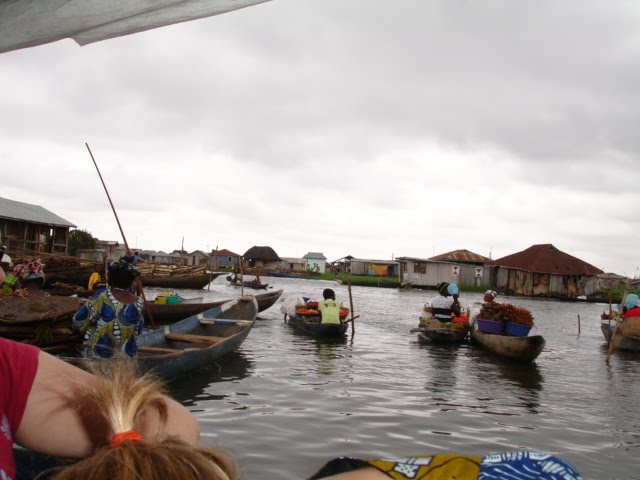
The village of Ganvie, one of the three stilt villages outside of Cotonou in the middle of a large shallow lake named Lake Nokoue. According to Wikipedia the village has 20,000 inhabitants. To travel within the village, villagers take their pirogues (traditional canoes). The coolest thing about this is the marche, where women row their pirogues to a central area with their boats full of fish, tomatoes, onions and piment. Villagers then row their boats up to the edges of the market and barter with the floating marche mamas for goods.
Maybe about seven kilometers from land
Wednesday, March 31, 2010
Aural Memory
“SUPPER!”
My mother’s voice would ring out like a dinner bell in a train yard. On the table there would be a delicious, cold green salad. On the stove, served buffet style, baked potatoes, steak with béarnaise, corn and green beans. For dessert there would be fruit, cookies or ice cream depending on the occasion.
“Vien, Manger!” or “WA, Kadje!”
The child lifts her sticky hand off pate up off the plate and waves it near my face, bringing the scent of the greasy, mutton and tomato based sauce d’arachide. Cornmeal boiled in water and beaten with a stick until it becomes pure starch, it sticks to everything. Pate Rouge, which is cooked with tomatoes, oil and onion and Pate Noir, which is as far as I can tell beans boiled and then beaten to a similar consistency, are two variations of the same meal. The sauce de legumes, de sesame, d’arachide, de tomate are the usual side dishes. You wash your right hand with water from a pitcher, pouring the run-off into a small bowl beneath. Sometimes there is soap. That’s always nice. You use that hand to grab chucks of pate and with some practice you then whip it around the sauce that settles nicely in a communal bowl. If you are wealthy, or at a restaurant, you can have wagasi cheese, goat, beef, or fish. The meat varieties are barely recognizable as they’ve been fried within an inch of their being and hard to chew. Wagasi is delicious, but difficult to find in Manigri. It is sold wrapped in big green leaves that turn the white skin a bright, beautiful red.
“SA-RAHHH, It’s TIME TO GET UP”
My mother’s voice again, jarring me from the dark haze of sleep. I’d fumble around in my bed, wracking my brain for any reason at all why I could not emerge from my room. I’d tumble out of bed and half crawl, half run to the intercom before my mother could decide to ‘beep’ me. My parents installed an intercom in my room when I was thirteen. The beeping sound, even when done accidentally, still irritates me to this day.
[ a cacophony of animals ]
The animals wake around five thirty in the morning. The roosters and goats must wake each other from their own rumbling sleep to then flail about the concession, screaming. Goats that sounds like small children, roosters that must want to fight everything in sight. And the sweeping. The sound of stiff bristles scraping against the sand.
“You fly, I’ll buy”
A monstrous building in the middle of a parking lot that could be full but once a year. Cars. Shopping carts. Seagulls eating trash. You drive yourself there, park it in a space and then march into the supermarket with the intent of only buying one thing. You emerge fifteen minutes later having in fact bought six or seven. Those companies are so much smarter than you. How did they know you’d find the 2 for 1 L’Oreal Shampoo sale so alluring, and when is the last time you ate White Cheddar Cheese-its? But there they are, in your ‘reusable’ shopping bag. Because you care about the environment and will absolutely use those petroleum-based plastic shampoo bottles again and again. And, I don’t know, fix your car with that cardboard box from the Cheese-its.
“Ouebo! Ouebo! Viens! Viens! Wa-Wa-Wa!”
The wrinkled ladies crouch down over their wares like they’d like to strike at your knees. There are people pushing in every direction, their shoulders digging into your back. Huge trays of food pass above as Marche Mamas with babies on their back walk by, balancing their entire stock on their heads. You argue, plead, and feign disgust over their prices. You walk away. You tell them that you know the real price (even if you don’t) and insist that they don’t rip you off just because you’re white. You reach into your pocket to pay her, and then it is her turn to be disgusted. “Il n’y a pas la monnaie!” They’ll exclaim, pouting at you. You stare them down, and for a moment it’s like the two of you will really fight over this transaction. Finally she’ll break down and shrugging walk off, leaving her stand (safely guarded by the other women hovering around anticipating your business), in search of change.
When you’ve found the gari (manioc powder), the okra (known as gumbo here), and maybe the dried beans you came for an hour later, you head is ringing from the incessant microphone that screeches “My Heart Will Go On” as a midi file, and you’re less hungry than you were when you came. Maybe it’s the goat meat sitting on the wooden stand collecting flies. Or the little girl who is peeing right next to the place where you just bought your vegetables.
“Well, what will it be?”
A gin and club with lime. Jack on the rocks. A martini. A seasonal microbrew, maybe with blueberries or orange slices, from the tap. It’s served to you in a frosted glass. The music croons via a juke box in the corner. There are three different televisions showing various sports games. If you’re a regular your drink is waiting before you walk in the door. There is ice. Delicious, cold ice. Everyone minds their own business for hours. There is no eye contact, no joining a stranger’s table, until those who are scamming to pick up sex for the night are left to feed on one another.
“Je voudrais une beninoise” or “Fu me Sodabee”
The skunked beer in a gritty green bottle. She will bring the beer in a little basket, but for some reason- no matter what bar you are in- she has to go back to the same place she came from for the bottle opener. Liquor is ten dollars a glass and they have no idea how to serve it, and so most of their mark-up is lost. The majority of bars have only beer or soda, the beers being limited to five different kinds of domestic or African imports. No two Beninoise beers are the same. Music pumps out of the nearest television at its loudest pitch, encouraging people to dance but making it difficult to talk. The Tantis sit with the men who they think will buy them sodabee, or perhaps pay for other services. There is no ‘girls night out’ in a society where women rarely have their own income, and so it can be assumed every girl in that bar is looking for the same guy (named John). Frequently someone will sit down with you and try to talk to you, to try to befriend you into taking them to the United States. Or give them money. Or buy them beer. Sometimes their advances are funny, usually irritating, and once in awhile just sad. The bartenders (the tantis) may be the worst of them all, but frequently also the saddest.
My mother’s voice would ring out like a dinner bell in a train yard. On the table there would be a delicious, cold green salad. On the stove, served buffet style, baked potatoes, steak with béarnaise, corn and green beans. For dessert there would be fruit, cookies or ice cream depending on the occasion.
“Vien, Manger!” or “WA, Kadje!”
The child lifts her sticky hand off pate up off the plate and waves it near my face, bringing the scent of the greasy, mutton and tomato based sauce d’arachide. Cornmeal boiled in water and beaten with a stick until it becomes pure starch, it sticks to everything. Pate Rouge, which is cooked with tomatoes, oil and onion and Pate Noir, which is as far as I can tell beans boiled and then beaten to a similar consistency, are two variations of the same meal. The sauce de legumes, de sesame, d’arachide, de tomate are the usual side dishes. You wash your right hand with water from a pitcher, pouring the run-off into a small bowl beneath. Sometimes there is soap. That’s always nice. You use that hand to grab chucks of pate and with some practice you then whip it around the sauce that settles nicely in a communal bowl. If you are wealthy, or at a restaurant, you can have wagasi cheese, goat, beef, or fish. The meat varieties are barely recognizable as they’ve been fried within an inch of their being and hard to chew. Wagasi is delicious, but difficult to find in Manigri. It is sold wrapped in big green leaves that turn the white skin a bright, beautiful red.
“SA-RAHHH, It’s TIME TO GET UP”
My mother’s voice again, jarring me from the dark haze of sleep. I’d fumble around in my bed, wracking my brain for any reason at all why I could not emerge from my room. I’d tumble out of bed and half crawl, half run to the intercom before my mother could decide to ‘beep’ me. My parents installed an intercom in my room when I was thirteen. The beeping sound, even when done accidentally, still irritates me to this day.
[ a cacophony of animals ]
The animals wake around five thirty in the morning. The roosters and goats must wake each other from their own rumbling sleep to then flail about the concession, screaming. Goats that sounds like small children, roosters that must want to fight everything in sight. And the sweeping. The sound of stiff bristles scraping against the sand.
“You fly, I’ll buy”
A monstrous building in the middle of a parking lot that could be full but once a year. Cars. Shopping carts. Seagulls eating trash. You drive yourself there, park it in a space and then march into the supermarket with the intent of only buying one thing. You emerge fifteen minutes later having in fact bought six or seven. Those companies are so much smarter than you. How did they know you’d find the 2 for 1 L’Oreal Shampoo sale so alluring, and when is the last time you ate White Cheddar Cheese-its? But there they are, in your ‘reusable’ shopping bag. Because you care about the environment and will absolutely use those petroleum-based plastic shampoo bottles again and again. And, I don’t know, fix your car with that cardboard box from the Cheese-its.
“Ouebo! Ouebo! Viens! Viens! Wa-Wa-Wa!”
The wrinkled ladies crouch down over their wares like they’d like to strike at your knees. There are people pushing in every direction, their shoulders digging into your back. Huge trays of food pass above as Marche Mamas with babies on their back walk by, balancing their entire stock on their heads. You argue, plead, and feign disgust over their prices. You walk away. You tell them that you know the real price (even if you don’t) and insist that they don’t rip you off just because you’re white. You reach into your pocket to pay her, and then it is her turn to be disgusted. “Il n’y a pas la monnaie!” They’ll exclaim, pouting at you. You stare them down, and for a moment it’s like the two of you will really fight over this transaction. Finally she’ll break down and shrugging walk off, leaving her stand (safely guarded by the other women hovering around anticipating your business), in search of change.
When you’ve found the gari (manioc powder), the okra (known as gumbo here), and maybe the dried beans you came for an hour later, you head is ringing from the incessant microphone that screeches “My Heart Will Go On” as a midi file, and you’re less hungry than you were when you came. Maybe it’s the goat meat sitting on the wooden stand collecting flies. Or the little girl who is peeing right next to the place where you just bought your vegetables.
“Well, what will it be?”
A gin and club with lime. Jack on the rocks. A martini. A seasonal microbrew, maybe with blueberries or orange slices, from the tap. It’s served to you in a frosted glass. The music croons via a juke box in the corner. There are three different televisions showing various sports games. If you’re a regular your drink is waiting before you walk in the door. There is ice. Delicious, cold ice. Everyone minds their own business for hours. There is no eye contact, no joining a stranger’s table, until those who are scamming to pick up sex for the night are left to feed on one another.
“Je voudrais une beninoise” or “Fu me Sodabee”
The skunked beer in a gritty green bottle. She will bring the beer in a little basket, but for some reason- no matter what bar you are in- she has to go back to the same place she came from for the bottle opener. Liquor is ten dollars a glass and they have no idea how to serve it, and so most of their mark-up is lost. The majority of bars have only beer or soda, the beers being limited to five different kinds of domestic or African imports. No two Beninoise beers are the same. Music pumps out of the nearest television at its loudest pitch, encouraging people to dance but making it difficult to talk. The Tantis sit with the men who they think will buy them sodabee, or perhaps pay for other services. There is no ‘girls night out’ in a society where women rarely have their own income, and so it can be assumed every girl in that bar is looking for the same guy (named John). Frequently someone will sit down with you and try to talk to you, to try to befriend you into taking them to the United States. Or give them money. Or buy them beer. Sometimes their advances are funny, usually irritating, and once in awhile just sad. The bartenders (the tantis) may be the worst of them all, but frequently also the saddest.
Tuesday, March 30, 2010
Happy Birthday Hannah. Hannah Happy Birthday.
The 9th of March and the first rain is here.
For two days it's been unmercifully teasing. The humidity rises, the clouds gather, flashes of lightning were flickering in the distance. But at 10:20pm, the hot silence finally broke and for the first time since October it rained. Odje. Nagot for rain. I haven't been this excited in a long time. The wind has been wrecking havoc all afternoon, kicking up dust and covering everything in a fine coat of brown, including me. I was reading outside and had to retreat into my house to hide from the small windstorm that made it impossible to see.
I lined up about six buckets beneath my roof so the rainwater could trickle into them. I'll use it to wash dishes and clean the sheen of dirt that has consistently covered everything in my house through the screened windows and doors for months. I'll use it to save Luc and Mouda and myself from carrying heavy buckets of water from the well. I'll use every drop. Water is so precious.Life is so beautiful.
Narcissis and Okounde barged into my house just before it arrived, animated and drunk, to talk about their plans to build a tall wooden fence around our row of houses. Narciss will co-opt students who arrive late to school or who are sent to him by frazzled teachers into building this fence. The labor will be free and we will only need to pay for minimal supplies. They are looking forward to cooking outside and sleeping on mats in front of the house. It is unsafe to do so now. I did not have the heart to tell them that I have a gas stove (They've never seen my house beyond it's elaborately furnished front room) and that I have been sleeping outside when the power is out between my shower and latrine on a cot, my mosquito net hung over the clotheslines.
I had been having an extremely difficult time adjusting back to life in Manigri after IST. It was difficult seeing all of my lovely friends and listening to their stories. My best friend in Peace Corps, my dear Emily MacDonald, is leaving to continue her service in Namibia. I had been depressed that she was leaving. The 107 degree heat and intermittent electricity was of no help either.
However, to bore you with some teaching details, before IST I had broken my classes up into teams. They were allowed to pick their names, and each activity now functions as a competition to earn points. I promised the team with the most points at the end of the year a prize. I think I will do something fantastic for them, but I will not yet say what it is. Anyway, this method has made teaching a lot more exciting for me and the students. They lose points for bad behavior and earn points for answering questions and doing well on exams and interrogations. It also helps that the bulk of my grading for the semester is over- nothing makes me feel more uneasy than staring at a stack of ungraded papers that I know will only make me feel inadequate as a teacher and desperate as a person who hates tedious desk work. I am now in the middle of calculating the averages for the semester, and it's been a pleasure noticing how my grades compare to the rest of the teachers. Either my exams are easier or my students are in fact learning.
Yesterday was International Womens Day. I took ten girls from my GIrls Club to Bassila on Saturday to meet with three other local PCV-run GIrls Clubs in Bassila, Pira and Pennesoulou. The girls had prepared sketches and I was so impressed with everything they had put together. The girls from Pira sang songs and danced, the girls from Bassila did a skit about sexual harassment in schools and unwanted pregnancies, the girls from Pennesoulou did a hilarious sketch featuring the much detested teacher 'Dieudonne'. My girls did a very simple sketch called, "Je suis." Each girl wrote a "Je suis" poem during one of our meetings which we then turned into a larger production where each girl named one thing that she was. Such as, I am a girl, and I am strong. Or, I am a girl, and I am a good example for other girls who want to succeed. I am a girl, and I am intelligent. I am a girl, and I can be the best in every domain. It was cute. We sang a lot of songs, including Rilo Kiley's "The Frug" and a song that proclaimed each volunteer as the mother of a family.
Unfortunately, while at the Maison des Jeunes in Bassila, someone had gained access to my purse and stole my cell phone, about thirty dollars worth of cfa, and about five dollars worth of phone credit. I was pretty upset about it for a short period of time. I just felt so stupid. However, thanks to my wonderful parents I was able to get enough money to make it through the next couple of weeks. When people ask me in village, even those who I haven't told but I suppose found out from others, I just tell them that i'm not upset and that money isn't everything. I suppose it isn't, now that I have some.
My friend Benjamin in Bassila had a visitor this weekend from Hamburg. The three of us spent Saturday night playing poker in a bar in Bassila. It was fun. I took Stephen (the foreinger) to see Manigri. It was kind of nice to have a westerner who hadn't been living here for the past seven months and show them around. He was very impressed by the cows, the flora, and- of course- the poverty. I was talking with our beloved Tanti at Marquis, the buvette I go to with my close-mates, and she told us that she makes 500 cfa, roughly a dollar, a night. Of course, as we discussed in a bit, depending on inquiring male customers, this amount could be raised. He was shocked that even for two dollars, someone could buy a girl. I explained that just about anyone you see in my village makes only 500 cfa on a good day. The women who sell tomatoes at the market, my lovely Petit Mama who sells yams on the road, the zemidjians- 500 cfa a day is barely a wage, but they survive.
I try to stay away from Peace Corps cliches, such as "Ups and Downs" to describe my experience here. However, I find that as it has permeated my perceptions as to my frantic mood swings in this country, that it is the only phrase that will suffice. Despite the fact that I was sad and lonely when I first got back to post, the past few days have been wonderful. Despite the heat. Despite the missing my friends. Despite my cell phone being stolen. I was asked about procuring mosquito nets for a local NGO, and I am going to go see my health center about planting Moringa. There is an orphanage to build in Bassila. There is work to do.
For two days it's been unmercifully teasing. The humidity rises, the clouds gather, flashes of lightning were flickering in the distance. But at 10:20pm, the hot silence finally broke and for the first time since October it rained. Odje. Nagot for rain. I haven't been this excited in a long time. The wind has been wrecking havoc all afternoon, kicking up dust and covering everything in a fine coat of brown, including me. I was reading outside and had to retreat into my house to hide from the small windstorm that made it impossible to see.
I lined up about six buckets beneath my roof so the rainwater could trickle into them. I'll use it to wash dishes and clean the sheen of dirt that has consistently covered everything in my house through the screened windows and doors for months. I'll use it to save Luc and Mouda and myself from carrying heavy buckets of water from the well. I'll use every drop. Water is so precious.Life is so beautiful.
Narcissis and Okounde barged into my house just before it arrived, animated and drunk, to talk about their plans to build a tall wooden fence around our row of houses. Narciss will co-opt students who arrive late to school or who are sent to him by frazzled teachers into building this fence. The labor will be free and we will only need to pay for minimal supplies. They are looking forward to cooking outside and sleeping on mats in front of the house. It is unsafe to do so now. I did not have the heart to tell them that I have a gas stove (They've never seen my house beyond it's elaborately furnished front room) and that I have been sleeping outside when the power is out between my shower and latrine on a cot, my mosquito net hung over the clotheslines.
I had been having an extremely difficult time adjusting back to life in Manigri after IST. It was difficult seeing all of my lovely friends and listening to their stories. My best friend in Peace Corps, my dear Emily MacDonald, is leaving to continue her service in Namibia. I had been depressed that she was leaving. The 107 degree heat and intermittent electricity was of no help either.
However, to bore you with some teaching details, before IST I had broken my classes up into teams. They were allowed to pick their names, and each activity now functions as a competition to earn points. I promised the team with the most points at the end of the year a prize. I think I will do something fantastic for them, but I will not yet say what it is. Anyway, this method has made teaching a lot more exciting for me and the students. They lose points for bad behavior and earn points for answering questions and doing well on exams and interrogations. It also helps that the bulk of my grading for the semester is over- nothing makes me feel more uneasy than staring at a stack of ungraded papers that I know will only make me feel inadequate as a teacher and desperate as a person who hates tedious desk work. I am now in the middle of calculating the averages for the semester, and it's been a pleasure noticing how my grades compare to the rest of the teachers. Either my exams are easier or my students are in fact learning.
Yesterday was International Womens Day. I took ten girls from my GIrls Club to Bassila on Saturday to meet with three other local PCV-run GIrls Clubs in Bassila, Pira and Pennesoulou. The girls had prepared sketches and I was so impressed with everything they had put together. The girls from Pira sang songs and danced, the girls from Bassila did a skit about sexual harassment in schools and unwanted pregnancies, the girls from Pennesoulou did a hilarious sketch featuring the much detested teacher 'Dieudonne'. My girls did a very simple sketch called, "Je suis." Each girl wrote a "Je suis" poem during one of our meetings which we then turned into a larger production where each girl named one thing that she was. Such as, I am a girl, and I am strong. Or, I am a girl, and I am a good example for other girls who want to succeed. I am a girl, and I am intelligent. I am a girl, and I can be the best in every domain. It was cute. We sang a lot of songs, including Rilo Kiley's "The Frug" and a song that proclaimed each volunteer as the mother of a family.
Unfortunately, while at the Maison des Jeunes in Bassila, someone had gained access to my purse and stole my cell phone, about thirty dollars worth of cfa, and about five dollars worth of phone credit. I was pretty upset about it for a short period of time. I just felt so stupid. However, thanks to my wonderful parents I was able to get enough money to make it through the next couple of weeks. When people ask me in village, even those who I haven't told but I suppose found out from others, I just tell them that i'm not upset and that money isn't everything. I suppose it isn't, now that I have some.
My friend Benjamin in Bassila had a visitor this weekend from Hamburg. The three of us spent Saturday night playing poker in a bar in Bassila. It was fun. I took Stephen (the foreinger) to see Manigri. It was kind of nice to have a westerner who hadn't been living here for the past seven months and show them around. He was very impressed by the cows, the flora, and- of course- the poverty. I was talking with our beloved Tanti at Marquis, the buvette I go to with my close-mates, and she told us that she makes 500 cfa, roughly a dollar, a night. Of course, as we discussed in a bit, depending on inquiring male customers, this amount could be raised. He was shocked that even for two dollars, someone could buy a girl. I explained that just about anyone you see in my village makes only 500 cfa on a good day. The women who sell tomatoes at the market, my lovely Petit Mama who sells yams on the road, the zemidjians- 500 cfa a day is barely a wage, but they survive.
I try to stay away from Peace Corps cliches, such as "Ups and Downs" to describe my experience here. However, I find that as it has permeated my perceptions as to my frantic mood swings in this country, that it is the only phrase that will suffice. Despite the fact that I was sad and lonely when I first got back to post, the past few days have been wonderful. Despite the heat. Despite the missing my friends. Despite my cell phone being stolen. I was asked about procuring mosquito nets for a local NGO, and I am going to go see my health center about planting Moringa. There is an orphanage to build in Bassila. There is work to do.
Sunday, February 21, 2010
It's Getting Hot in Here
(i am texting this blog post while riding a double decker bus to cotonou. Any grammatical errors must be ignored and all hope for any intellectual scope abandoned.)
First, even though just about all of you who read this never met him, i want to talk about my friend Jonathan Pratt.
You probably know the kind of guy he was. Larger than life. A musical prodigy who flew airplanes and rode his motorcycle on cross country trips at a whim. He wrote exhaustive, meticulous poems in thin black ink. He had a smile that turned the head of everyone in the room and a voice that could break your heart. He didn't walk through the dorms, he strut and swayed, singing The Doors through the halls. He was always reinventing himself while remaining the guy everyone wanted to be friends with. To party with. To play music with. To talk with. He was the guy who when he focused on you, made you feel like you two were seated on top of the world.
When a loved one passes away you're supposed to list their generous, inspirational qualities. People use phrases like 'hero', 'angel', (and 'larger than life') and forget under the niceities, there was a real person. Someone who you loved not only for their gifts but also their faults. It always seemed incredibly disingenious to me, this praise of the dead. I bring it up because i want to try to convince you that i wouldn't exaggerate. If there ever was a Paul Bunyan in my life, it was Jon Pratt.
It was spring in 2005. I was walking from a stuffy lit theory class with my (ex)boyfriend Adam, revelling in the warmth and the sight of lilac blossoms. A wafting acoustic guitar played the most aggressive Dylan i've ever heard. I craned my neck at the sound of Jon's voice. There he was, all six foot three, fifteen feet in the air, perched comfortably on a huge industrial art monstrocity in the middle of the courtyard. Grinning, radiant, beautiful. Adam and i scrambled to the top, to be near him. We sat there for the better part of an hour. Students walked past, grinning outright or with bemused smiles on their faces. It was an afternoon that to this day reminds me of how beautiful it is to be young and in love.
Jon shone in my life for a short three years when he went off with his band to L.A. to record an album. When he came back home he was different, sick in someway we could not identify. He still rapped poetry with the best of us. His fingers still stretched over his keyboard with prolific intensity. But he joked less, his charasmatic smile seemed held back beneath increasingly desperate eyes. Jon killed himself one year ago last week. I haven't been able to listen to Subterrean Homesick blues since without thinking of how when Jon looked you in the eye and smiled, he eclipsed the sun.
A note about comments: apologies are nice, but unnecessary. I'm sorry too, especially for his family. If you knew jon, you would be sorry too. If you didn't, it's really ok. Let's leave it at that.
Chaleur is here. It's been over 100 for the past three days, and i'm sure the worst is yet to come. The humidity is low though, thank god. It still gets cool in the early hours of the morning until the sun rises without all that water in the air. Thank god i was placed in the North.
That's all for now. If i have any time at a real computer this week (doubtful), i'll try to write again.
À la prochain.
First, even though just about all of you who read this never met him, i want to talk about my friend Jonathan Pratt.
You probably know the kind of guy he was. Larger than life. A musical prodigy who flew airplanes and rode his motorcycle on cross country trips at a whim. He wrote exhaustive, meticulous poems in thin black ink. He had a smile that turned the head of everyone in the room and a voice that could break your heart. He didn't walk through the dorms, he strut and swayed, singing The Doors through the halls. He was always reinventing himself while remaining the guy everyone wanted to be friends with. To party with. To play music with. To talk with. He was the guy who when he focused on you, made you feel like you two were seated on top of the world.
When a loved one passes away you're supposed to list their generous, inspirational qualities. People use phrases like 'hero', 'angel', (and 'larger than life') and forget under the niceities, there was a real person. Someone who you loved not only for their gifts but also their faults. It always seemed incredibly disingenious to me, this praise of the dead. I bring it up because i want to try to convince you that i wouldn't exaggerate. If there ever was a Paul Bunyan in my life, it was Jon Pratt.
It was spring in 2005. I was walking from a stuffy lit theory class with my (ex)boyfriend Adam, revelling in the warmth and the sight of lilac blossoms. A wafting acoustic guitar played the most aggressive Dylan i've ever heard. I craned my neck at the sound of Jon's voice. There he was, all six foot three, fifteen feet in the air, perched comfortably on a huge industrial art monstrocity in the middle of the courtyard. Grinning, radiant, beautiful. Adam and i scrambled to the top, to be near him. We sat there for the better part of an hour. Students walked past, grinning outright or with bemused smiles on their faces. It was an afternoon that to this day reminds me of how beautiful it is to be young and in love.
Jon shone in my life for a short three years when he went off with his band to L.A. to record an album. When he came back home he was different, sick in someway we could not identify. He still rapped poetry with the best of us. His fingers still stretched over his keyboard with prolific intensity. But he joked less, his charasmatic smile seemed held back beneath increasingly desperate eyes. Jon killed himself one year ago last week. I haven't been able to listen to Subterrean Homesick blues since without thinking of how when Jon looked you in the eye and smiled, he eclipsed the sun.
A note about comments: apologies are nice, but unnecessary. I'm sorry too, especially for his family. If you knew jon, you would be sorry too. If you didn't, it's really ok. Let's leave it at that.
Chaleur is here. It's been over 100 for the past three days, and i'm sure the worst is yet to come. The humidity is low though, thank god. It still gets cool in the early hours of the morning until the sun rises without all that water in the air. Thank god i was placed in the North.
That's all for now. If i have any time at a real computer this week (doubtful), i'll try to write again.
À la prochain.
Subscribe to:
Posts (Atom)