

And to my mother, Happy Birthday.
They roar past like ghosts on their tired, choking motorcycles. Harmattan sands cake their skin and clothes. Many peer past clouded goggles protecting their eyes from the intrusive grit. These gray specters fly down terre rouge on their way from Nigeria near the end of every December. It's the rural exodus.
Nigeria's farming and lumber industries pay more, drawing economic migration from all over the country. At Christmastime, however, the migrants come home. The small dirt paths leading to villages all over Benin are crowded with moto-caravans, racing by in groups of eight or nine. Big, eighteen-wheel trucks, carry loads men in their beds. Men who cheer as you wave to them. Men on their way home. They're always blanketed in gray, a mix of ash from the fields being burned and the choking dust clouds of Harmattan.
In Manigri, you can tell when someone has finally come home. In my house I can hear cheers erupting from all over Ikanyi, as entire concessions pour out of their homes to greet their returned brothers. It's difficult to describe. For these men, their entire lives were spent in these concessions, surrounded by multiple inter-married and related families. And then they had to leave. Leave their mothers, fathers, wives, children, to seek work and better wages in a different country with a new language. They bring back gifts, the back of their motos are weighed down with cement sacks; pockets heavy with money. But the real gift, of course, is themselves. And it's not just the concession that celebrates- the surrounding concessions come out. Old mamas, babies, papas, brothers, cousins, sisters rush out of their homes to see the stranger who has returned. It's pandemonium and joy and possibly the most beautiful thing I've ever seen.
They don't really come home for Christmas, however, as you may think. Christmas is largely seen as a holiday for children. Papa Noel is just some cartoon character that gives presents to little kids. Of course, most kids don't get Christmas presents as families save their kabri for the New Year celebration, a feast that lasts up to three days. That is the real fête. While I never felt as though we celebrated a religious Christmas in my family, there remains a nostalgia for snow, lighted trees, and the general spirit of love, generosity and kindness encouraged through the season. This is the kind of nostalgia that makes me choke up when teaching my students, "We Wish You a Merry Christmas" in class. (I'll chalk this emotionalism up to not having had to endure christmas music, obnoxious advertising or shopping mall santas.)
The new pastor and his wife (of the church directly behind my house) are possibly the sweetest couple I've ever met. Their speech is soft and they shake hands earnestly. I like visiting them to ask them about their chickens, the service, the choir, etc. Last time I was sitting in their house, I glanced into one of their side rooms to see a stack of boxes. The side facing me read, "Samaritan's Purse". Where have I seen that before? I got up from my vastly uncomfortable seat to examine the cardboard boxes. "Operation Christmas Child." No. No way.
I was just talking about them last year in a scattered blog post. My sisters and I would get a slip of paper with the information: boy, age 13. or girl, age 3 typed out on it. We'd fill a shoebox with hard candy, small toys and picture books. It was, looking back, one of the better parts of Christmas. And as I wrote last time, as a kid I knew someone would put in a little book about Jesus and Christianity in attempts to proselytize, but that didn't bother me. The generosity and uncommon kindness to strangers was more appealing to me than any religious basis for the organization.
And then, there they were. Shoeboxes little girls and boys filled with hope for a merry christmas to kids they could never hope to meet. Shoeboxes filled with toys that will undoubtedly bring so much joy, excitement (and confusion) to the homes of children who have only tin cans and matchbooks to play with. I remember vividly helping my mom stuff socks and a toothbrush into a shoebox and wrapping it, wondering about the lives of those children abroad in the Philippines or yes, Africa. And now , staring there I was, staring at the same boxes that I had once wrapped. And I know these kids now. And those kids. It was like straddling the continental divide. It was miraculous to me that in all of the churches in Benin, this small mud-brick congregation was a recipient of Samaritan's Purse, and that I had the opportunity to be on the receiving end of someone else's generosity and charity. Someone else's christmas wish, if you will.
I know there are a lot of people out there who don't celebrate or even particularly like Christmas. I used to be one of them. In the United States it's really easy to see the seedy underbelly of this vastly commercial holiday. However, once removed from the status quo of gift-wrapping, terrible television commercials and nerve-wracking economic analysis, I find myself discovering what the holiday means to me. It's a shoebox, wrapped by small hands in the United States and opened in the bush of Africa.
With that I'd just like to say, Happy Holidays. I miss you all.
Wednesday, December 22, 2010

Saturday, October 2, 2010
Mirror Phase
What is the phase in Child Development Theory that toddlers finally understand that just because someone has walked out of a room, they haven’t vanished forever? The way things changed since I Ieft post have been unsettling; as though I expected Manigri to remain static during my prolonged absence this summer. My ‘sister’ Rafia (17) moved out of Mama's house and to Oke, where she's living with her 'husband.' Mama Victoire is now Mama Ines. The new baby is soft and sweet and smells like every other baby I've ever held. Sidou has a new baby brother, now there is a Mama Edison. Jo Jo is starting primary school, and he was so upset about it he hasn't been the same kid. It’s like he finally realized that at some point he's going to have to stop running through the bush naked. He's going to have to grow up; the inertia of the world is far too strong for him and his big belly.
The last time I was here it was the Fete for Ramadan. I live in an all-Christian concession, and so I had to seek out people to celebrate with. I ended up going to Bassila to see Mazou and a few of his friends. We saw a soccer game and ate at my favorite buvette despite the fact that we were invited to swankier restaurant nearby. Yvette, a tanti from Camp Sucess, was there in meme tissue with her friends. She chasitized me for not calling her to tell her I was in town. I smiled because I knew that it wouldn't have made any difference. She's too much of a big shot for me. Manigri was so loud, the air vibrated. I couldn't hear the bleats of goats over the stereos pumping and pilees pounding. Mama made cous cous and goat that actually tasted almost good. I have never been a fan of her cooking. It always makes me a little queasy. Perhaps it was the goat tooth I found in the bushes after throwing up my first night at post. Or perhaps it's just that she actually doesn't care how food tastes, just that it gets made.
Mama's little buvette literally exploded over the summer. She received a loan from her savings and loans group facilitated by (Danish NGO) Bornefonden. She built a small concrete store, where she now sells a lot of liquor and things such as detergent, cous cous, spaghetti, sardines, mayonnaise- basically all of the things that the other stores in Manigri sell. This has greatly dampened my incentive to go into Oke or even into greater Ikanyi since I've arrived back. Why go searching for toilet paper when... Oh yes, she sells toilet paper too. Just steps outside my door. I can yell from my couch and magically it appears in Gi's hands, his grinning face peering through my screen door. As a result I haven't seen my Nagot ladies in a long time, and I haven't gone to salue anyone but Olivier and the Director. Edwidge and her family moved to another town up north, I forget the name, but the same place she was born. I have no idea who the new pastor is. Papa's cousin in Oke died a few weeks ago, I missed the ceremony. KoKaDa (my cat) is pregnant. It's just so strange to be so estranged from a place that is so strange, and yet I am the stranger.
Also, petit chaleur has begun. Right now the sky is threatening rain and I can see lightning bickering around the edges of my back wall, but it is so bright and hot in the sun. I still have full buckets of water almost every couple of days, which is a luxury I am unsure as to how I ever lived without. Harmattan will be here soon and it will grow cold. I smile thinking about how during December the professors would show up at school in their down jackets and hats, asking me how I liked the cold. I always told them I loved it, that it pleased me, that I thought it was so much better than the heat. They'd laugh and shake their heads at my enthusiasm for the la frecheur. I wonder if it will feel as good this year, or if I too will be showing up dressed like a zemidjian, rubbing my hands together as if over a fire.
I have begun working on planning a bike tour for the Donga Region. I'd like to do about seven or eight hand-washing formations from Bassila to Aledjo and then up to possibly Djougou this Harmattan. After that I will begin planning the "Best Pratices: Camp BLOW and Camp GLOW" workshop for January. Then it's monthly meetings for Camp Sucess and Camp Espoir until July. Oh, and teaching. Of course. And Girls' Club, bien sur.
I have no fear that as I become habituated again I will venture out farther from the confines of my concession and experience more. There are always ceremonies and babies and school activities to go to. There are always people to have late evening conversations with about America, race, gender, development, time and, mostly, the familiar sound of silence. There are a lot of things in my periphery. I just want to focus on the most important ones, which are all right in front of me. My work, my friends, and my life in Manigri.
"We ought to see that the work that needs doing for [the poor] in their misery, not as mere "good work", but as a duty that must not be shirked." Albert Schweitzer.
Sunday, July 25, 2010
Au Revoir Nos Cheres Amies
Immediately after returning from the United States, there was Camp Sucess. I didn't have time to go back to Manigri, I met everyone in Djougou with a duffel bag full of tuna fish and ostrich jerky. I had always been told that the highlight of one's service was camp. Within the first day it was easy to see why. The way the girls' eyes lit up when they sang and danced. How motivated and interested they were in every activity- even the more difficult ones. How many of them had never seen a city as big as Djougou, or perhaps had ever been outside of their villages- and there they were, at a cyber cafe in the biggest city in their region, googling Michael Jackson.
My post has had a special relationship with this camp for almost five years. The first Volunteer in Manigri, John, created it with my current counterpart Olivier. Olivier then worked with Carly for two years on the same camp, culminating in a mega-ultra huge wonderful fantastic spectacle known as the current Camp Success, where 12 villages send 60 girls to Djougou for six days. It's the largest girls' camp in the country and also the most intense. By the end of it, there wasn't a dry eye in the room as my girls sang "Au revoir de notre cheres amies", one singer barely able to croak out the refrain, tears streaming down her face.
In teams of eight and paired with both a Volunteer and a HCN "Tanti", they learned about sexual health, stress, the importance of education and self esteem. They spoke to a panel of great professional women, they climbed a mountain, they saw Tata Sambas, they learned the greater art of journaling, they did yoga and sang songs. So many songs. So, so, so many songs.
We talked through-out the planning process about whether or not a girl could come back for a third year to Camp Sucess. It didn't feel right somehow that the same girls could come year after year when in reality we needed to help as many as possible. It was heartbreaking to watch the girls say goodbye to their friends. It was also heartbreaking watching my friends say goodbye to the girls knowing they too would be absent next year. As we do two year tours, so will they. And in between laughing and crying we'll find time to work and teach and learn. (oh yes, I am that cheesy)
Jessica Bruce, Naima Ferrell, Melissa Perry and Benjamin Jakob will all be leaving the greater Bassila Commune in two weeks for their homes abroad. I want everyone to know what an enormous inspiration and help they've been to me this past year, and that no one will ever be able to replace them. I only hope I can do what I can next year to be as half as influential as they have been to me.
I will leave Saturday to work Stage for the new Volunteers who have just arrived. I will not be back in Manigri until likely September. If I am at all difficult to reach during this time I apologize, I imagine a busy and interesting month is ahead.
Coming to America, Coming Home
I feel as though there would be something amiss if I didn't take the opportunity to compare, once again, America and the United States.
I left for Boston the 2nd of June. It was late. With my large army surplus knapsack and small laptop carry-on, aided by my friend Kara, I slowly hoisted myself from the zemidjian and onto the broken sidewalk. My stomach was twitching nervously as I gazed at the large, formerly unfamiliar building in front of me. Kara walked me right to the line to check in and hugged me good-bye.
"Enjoy America," she said.
"I will," I replied robotically, my eyes shifting around to make sure my luggage was safe in front and behind me. Then she disappeared, I saw her blond hair and white arms for just a moment before she shattered into a million pieces and I was on the plane.
The man next to me was a Sergeant with the US Military. I didn't want to talk with him at first. I thought he would try to hit on me. I had been conditioned to not talk to men unless I had to. It's just easier to ignore them outright instead of engaging them and finding it necessary to do so later when they start harassing you to give them your phone number. He was nice. He had a blond mustache. He thought my Nagot was endearing. He was training Beninese soldiers near the Nigerian border. He uniform faded into the gray of his airline seat as I dozed off.
The food. So much food. Every time I awoke, Air France fed me. Dinner, breakfast, lunch and a snack. Real butter. Cheese. Bread. I couldn't touch the wine, worried it would be too rich. Clean, cold water was a blessing in a plastic cup. On the plane ride to Benin the first time, my friends Rich, Bradley and I all got drunk on the complimentary airline size bottles of wine. We were raucous and giddy with red mouths and teeth. I drank because I knew I wouldn't be able to sleep on the red eye flight, never having had to get used to sleeping sitting up. This flight I couldn't keep my eyes open. I didn't have time to watch an in-flight movie or listen to music or read. I just slept, lulled by the peaceful ride and vibration and relative infrequent bump in the road.
At Charles de Gualle I stared in wonder at the series of automatic revolving doors. Thinking about how revolving doors were so efficient. I drank a cup of coffee and listened to my Ipod for six hours, marching up and down the terminal trying to see what I would like to buy. The New York Times was sold out, I settled for the Herald Tribune. I watched lovers entwine their legs beneath cafe tables and harried parents usher small children past men in wrinkled suits with sunglasses. I tried to write. Nothing came out. I was tapped out. Dry. My brain was overloaded in the way that it was when I first arrived in Benin. Culture shock. I didn't want to talk to anyone. I didn't want anyone to know who I was or where I was coming from or where I was going. I was anonymous, the way many Americans like to be.
Arriving in Boston I was elated to see David. A pair of cow horns strapped to the top of my knapsack made it difficult to walk, they were almost twice as wide as my body and tied near my neck. People stopped and stared from their cars as we walked to his apartment. I felt as though I looked like a minotaur. I spent two days delirious. When I closed my eyes I'd see JoJo running through the bush, naked, as usual. I'd see my mama walking back and forth from the the house with a pan of water to wash dishes. I'd see Mouda scrubbing laundry beneath the mango tree. Red dust. Roosters. The constant sound of women pounding meager tubers into food. The call to prayer. Then I'd open my eyes and see cars, skyscrapers, white people, glass windows, asian people, curtains, brown people, soft beds, food. So much food. So, so much food.
Finally when my brain caught up with the rest of my body and realized where I was, it was time for all of that good food to make me sick. At a very nice Indian restaurant in Porter Square I suddenly realized I couldn't eat all of those saturated fats and sugars anymore. Perhaps it was a virus or food poisoning- or perhaps I just wasn't used to the way I used to eat. In the United States, food and restaurants serve as forms of entertainment. Eating is a leisure activity, typically served quickly and enjoyed with friends or family in a way that seems more foreign than ever now. Americans don't break bread over the same dinner table as their parents, they're sharing naan at trendy establishments with tall cafe tables and wifi. I can't tell you how many lunches served as 'visits' over the following two weeks.
The next two and a half weeks were a whirlwind of faces, similar questions, toasts, and travel. I saw my family for nearly a week and a half, successfully visiting with all of my sisters, friends from high-school, college and gave a small presentation to my sister Bek's 1st grade classroom. I realized dressed in "traditional garb" (A bunch of panges I wrapped around myself because I didn't think to bring any modeles), and speaking in front of a class of students that I was conditioned to speak with an African accent, my voice slow and consonants softened. I had found my teacher voice, and it was from West Africa. I danced the "chicken" dance, a kind of difficult and awkward dance, in a bar in Albany. I fell asleep into my chinese food in Queens after talking about buruli ulcers. I walked through Prospect Park thinking about sacred forests and urbanization. I complained that my friends walked too fast, were too scheduled, that the subways felt like slave ships. There was no time to sit. I couldn't write, I had barely enough time to sleep. I thought back to my days at the New York State Senate and college, how if I had just one day in two weeks were I didn't have plans it was a blessing. If I could finish a newspaper I didn't have enough to do. I began to see Benin as a bit of a haven, where my time was freer, the faces friendlier, and the work rewarding.
Frequently Asked Questions:
So how was Africa?
-- It was/is fine(?)
What do you eat out there?
-- Uh, grits beaten with a stick until starchy. Sauce made from fish and tomatoes.
What else?
-- ? Whatever I can find.
What is the most messed up/ scary thing you've seen?
-- Why would you want to know the answer to that question?
How do you go to the bathroom?
-- I have a latrine.
So no running water, huh? Wow. How about electricity?
-- Yes, but it does go out sometimes. I'm lucky to have it though.
When do you come back?
-- I don't know. Probably September 2011.
Why not sooner?
-- I don't know. I can't make plans that far in advance. On verras.
I met Chris Kotfilia, a friend who also served in Peace Corps Benin, in the same coffee shop where we used to work together. He asked me what kind of Volunteer I became. I instead just listed every kind of volunteer one could be before deciding that I had no idea. I don't have the luxury of categorizing myself and my work in that way. He told me about how he goes to Chinese markets to try to find West Africans. How he now mentors a middle schooler whose family is from Savalou. We talked about how we didn't want Benin to be 'It', the one cool thing you do in your life; the one accomplishment that you always draw on for your world perspective. He's thinking of traveling, but is juggling first world responsibilities such as degrees and long term relationships. I felt relieved to not be wearing the same cement shoes, even if my feet are tainted red.
After another six days with David, I left for Paris. I said to him as I was packing that I was worried I'd be crying into my complimentary wine hovering over the Cotonou airport. However, the plane was comfortable, even though they fed me too much again. Instead of crying on the final descent, I felt relieved. Benin was going to be my home for the next year, and it felt good to be home.
Sunday, May 30, 2010
Small Victories in the Bush
Yesterday I made a point of being difficult as possible as I was packed into the backseat of a taxi tottering back from Djougou. As the driver slammed shut the door I protested, "Chaffeur, this car here, it's a five place. Not a nine place. Now with nine people there, this is dangerous." He shrugged and offered the common response to any foreign complaint, "This is Africa." I didn't let him off that easy. "It is not Africa. It's Benin. You think that in Ghana and Nigeria the chaffeurs put the people in the taxis like this? Absolutely not. It's not like this in all of Africa. It's only like this in Benin. Because the chaffeurs want to eat money. They are bandits. They bouf." (Bouf means to be gluttonous, it can be used for food or for money- it's especially used for bribes) I shoved my hand to my mouth to make my point.
A chorus of voices rang out in agreement, complaining that they shouldn't have to be made to sit like spoons in a drawer. Especially, as one woman pointed out, the old mamas in the backseat, hunched over, their tiny backs spindled awkwardly as they rested against the seat in front of them. "It's us who give you money, chaffeur. It is not you who must decide if there is a place for another person. We are the boss. Not you." The chaffeur started explaining that he doesn't make a lot of money, that with the price of gas and the "taxes" (bribes) he must pay, he only makes five mille (ten dollars) to go from Djougou to Bassila. I was outraged that he would dare to tell me that wasn't enough money. That's more money than even I make. I have to pay him three dollars, an entire day's wage, to go from Djougou to Bassila, typically sharing my seat in the front with some stranger, the stickshift awkwardly beneath me, and stop in every small village- sweating in the hot sun. I don't know why, but I couldn't just leave him alone.
I told him that every day there are buses that go from Cotonou to Nati, and that they are less expensive. That in a bus, you have your own place and you don't need to share your seat. That one day, there will be no taxis because there will be enough buses and everyone will know that the bus is better than a taxi because the driver isn't greedy.
The little mama next to me began whimpering a little, which infuriated me further. My legs cramping, I stood up, with half of my body out the window, and sat on the door. My legs and waist rested firmly in the car. I motioned to the mama to rest back against the seat where my back had been. It was far more comfortable up there on the door, my body out the window. The taxi was an old Peugeout, and sputtered at about 35-40 mph. It didn't feel dangerous. The chaffeur started yelling at me, telling me to get back in the car. I refused. The mama looked worried but smiled at me, perhaps grateful for the opportunity to rest.
And so I stayed there. Big trucks rolled by, the men on top of them yelling out, "Heyyyy Batouri!" I hummed quietly to myself and stared at people staring at me. I thought about grabbing my moto helmet and wondering if this was at all against Peace Corps regulations. At the next petit village one of the marche mamas who shared the three place backseat with the other seven people, including two children relegated to laps, got out and began unloading her chickens and cement sacks from the back of the taxi. The chaffuer got out of the car and stared down at me. I met his eyes and didn't dare blink. He told me to get back in the car. I told him I would only get back in the car if he promised not to put anyone else in the back seat. That five people was too many. Four people and two children were enough. He stared at me a moment, then shook his head and sighed, "Batouri...". I shrugged. I was pretty happy sitting up there, and it didn't matter to me if he kicked me out of the taxi entirely- which I knew he wouldn't do because he wanted my money. "On y va?" I asked. "Yes, let's go." I got back in the car, my face a slightly different color than the rest of my body from the dust. The ladies in the back seat looked satisfied, but I knew they were thinking I was absolutely crazy.
And to a degree, I was a little crazy. It's absolutely acceptable and common practice to put nine people in a five person car. Four up front, five in the back. Somedays though, I don't want to deal with it. It wasn't even so much about my comfort, although that had something to do with it, but the fact that this little old lady was visibly in pain by the way we were crammed in together. It was the idea that the passenger is at the mercy of the driver. It was that we were women and relegated to the back of the bus, as it were. I don't usually take it upon myself to yell at Beniniese people and argue with them, because I know that it won't make any discernible difference. However, sometimes you just want to pick a fight. I chose that taxi driver as my opponent.
And I won.
Thursday, May 20, 2010
Waiting for the Man
The first set of devoirs are finished, leaving me with approximately 200 papers to grade this weekend. I was hoping that since the material was something we had covered in great detail, and that I held a review session immediately before the exam, they would do fairly well. Unfortunately that was not the case. Not that they did especially terrible, but I am still coming to grips with lowering my expectations.
I am traveling again for most of June, a trip I am incredibly excited for. To do this, I will have to grade another set of 200 quizzes and devoirs. My Director was very compassionate and kind to allow me to finish the school year early, aided by the fact that I was one of very few teachers (Hafissou and Narcissis included) who continued to teach during the strike. Not that I had a choice, I am an apolitical employee and not paid by the state, therefore I have no recourse and could not participate in the strike even if I had wanted to. I guess I am using this opportunity to procrastinate my grading for just a few minutes, until it is time to sit down with the red pen and grade books.
In Cotonou, my dear friend Bradley Mock and I were out at a bar known as "Sunset", which rests right on the beach, overlooking the oil tankers trudging back from pillaging the Niger Delta. The sun was setting over the water in the West. It was cool and the waves were heading out to sea. A group of young men and women were pulling these enormous, heavy nets to shore. They were singing. We watched for awhile, lost in the fantastic reality of their lives. It was then that Bradley stood up, finished his Beninoise and said, "I'm going to go out there." Grinning and sipping my own beer, I told him he probably had to.
He came back forty-five minutes later, sweating and elated. He told us that when he went out there they were calling to him, "Yovo!" Brad's post is in a Mahi village, and so he speaks decent Fon. He told them, "There is no yovo here, I'm Fofo." (meaning "brother") As he picked up the net to help pull in the fish, against the current, the young men started chanting "Yovo... yovo... yovo..." As he stayed and continued to work, the chant changed. It was only a matter of time, with the rhythm of their pulls, that they began to chant "Fofo... Fofo... Fofo..." When the fish were in, tangled in garbage and tangled netting, they offered him some. He politely declined. There wouldn't be much use for the fish back at the bureau. I feel a bit strange telling Bradley's story for him, he has his own blog somewhere in the Peace Corps Blogosphere. I only hope he takes the time to tell his own version.
Right now I am baking brownies to give to Narcissis, Okounde and Mama's family. It has taken me awhile to get used to the idea of sharing food in the way that I am encouraged to. A Volunteer was telling me that in her village a popular phrase is, "If there's enough for one, there's enough for two." The numbers are interchangeable depending on how many people are sharing the meal, "if there's enough for three, there's enough for four," and so on. Last week, I was talking to a very drunken man in my village who was describing, in broken French and Nagot, about Fou-fou, or manioc, and some kind of sauce I am not familiar with. He smiled with a far away look in his eyes. "That is the kind of meal that would make you full." It was a startling realization for me that very few people have the resources available to them to eat until they are satisfied. Yet they are constantly offering food to share. While I may still guard my precious tuna fish and other goodies sent from the United States, I do see it as part of my responsibility to share what I feel I can share. My sister sent me some protein powder that I mixed with powdered milk and honey that I gave to Luc and Gi until it ran out. Once, while resting with me in my home, Mouda asked me about an apple that was sitting in my basket. It took a long time to convince him that "pomme" was not "pomme de terre", a potato. He had never had an apple before. When I gave it to him, he was so happy. "Please," he said, "the next time you travel, could you bring me back another one?" I was happy to oblige.
There aren't enough nutritious foods here. Not enough vegetables or fruits, even for someone who is supplementing their African diet with Western goods. The ones that are available are expensive. Yet, I find that the more I give, the more I receive in return. Coming home from Natitingou this weekend, I opened my fridge to see a small wheel of wagasi, the Fulani cheese, wrapped in aluminum foil. A gift from Luc. Edwidge, the pastor's wife who lives behind my concession, brings me tomatoes and little bits of corn when she can. My mama is always asking if I've already made food for myself, inviting me to eat with them. I typically decline the offer, as I prefer my spanish rice to her really greasy, kind of gross, food. However, the sentiment is... heart-warming. I do not cook here because I have to, but because I want to. There are more than enough people who care about me that would take care of me if I needed it. I'm slowly learning about living in a communal society. It's people to share food with, to cook with, to ask advice and laugh with. When bad things happen, they're the people that shake their heads solemnly and click in the back of their throats. When someone dies it is the entire village who mourns, and if the person was old enough, celebrates.
I was complaining to my mother the other day about the stress of living in a concession where everyone feels as though they are part of your family. I do not live in a house, per say, but in very large room in a very large home. If I am not up and my doors are not open by 9am, it is my Mama who comes by the house asking if I am sleeping or sick. If my doors are open past 10pm, it is Papa or Narcissis who will call to me to close my door and go to bed. All day I receive visitors from different places in my village. The children in my concession, other teachers, Edwidge, my neighbors, Papa, they all come by to saluter me and ask if I've slept well, if I am going to cook food, what I am doing for the day. Sometimes it's really frustrating when I think back on my life in Albany, when if someone wanted to come visit me they would call my cell phone before coming over. I could rest in my house all day and do work without interruption. I could lie around naked and socialize via instant messaging or email without leaving my room. I miss that independence, to make decisions for myself regarding where I was going and what I was doing. My Mama will absolutely not accept me coming home from Basilla at night, even though I have no reason to believe it is dangerous. She doesn't want anything bad to happen to me, but at 23 years old, I really believe it is my decision. Still, the few times I have done so, because I had school in the morning or just needed to come home, I was apologizing. "Ne pas fâche, eh Mama?" Don't be mad Mama. Your daughter is a grown woman. She needs to be able to do things for herself.
Speaking of daughters, Mama's third oldest daughter, Rafiatou, is pregnant. She is seventeen years old. I have not had the audacity to ask about the father, and I assume someone will eventually tell me. She is no longer in school and spends her days beneath the mango tree, resting on a mat. I don't feel responsible, per say, but the situation does make me think about how the importance of sex education. Rafia is not in my Girls' Club, as it was a selective process. I wonder if the experience of being in those conversations with the Sage Femme about pregnancy, sexual health and female empowerment would have made any difference. It's a moot point, I know, but it's a sad realization that Rafia will probably not finish her schooling now. On a more positive note, I am excited to meet this baby once it comes into the world. (She says she thinks it's a girl, but we'll find out come November)
Back, a long time ago, I used to go to Christian Sunday School. It wasn't that my parents were especially religious, but the United States being a predominately Christian nation they felt it was important for me to gain a good understanding of the Bible. Every Christmas, after the mandatory Christmas Story Pageant, there would be an "Operation Christmas Child" drive, where we would fill shoeboxes full of small toys and candies to be sent overseas to children who would undoubtedly never have seen a Christmas with presents. I know that someone, somewhere, would add little brochures about Jesus and salvation and all that, so children would understand who was sending them these gifts (and why).
I think I would like to do something similar, but perhaps without the Christian overtones. There are a lot of little girls here who ask me if I can help them get a "bebe", and little boys who would love a soccer ball or a toy car. I know I am not supposed to be giving gifts, in fact, I frequently remind people that I am not "Papa Noel". However, the children that I love and have a personal relationship with I feel deserve at least one toy. I know children will play with anything, I see them stacking dead batteries and playing with empty tin cans and making little cooking fires to play their version of 'House'. Yet, just a few baby dolls or stuffed animals, just a few toy cars or picture books with simple French words, would light up these children's lives. I don't know how I want to do this, but it's an idea that I've been slowly mulling over as I see their small hands working through-out the day, gathering wood, cleaning pots, clearing brush, sweeping the ground, and hoeing the fields.
I suppose that is all for now. Back to the grind. Wish me luck!
Thursday, April 1, 2010
Scenes of Benin

My Nagot Tutor and Friendly Roadside Peanut and Okra Saleslady

Mama's Stand (palm oil in the front, cookies in the back)

Door to Door Salesgirls (frequently eggs, this time it was spaghetti and condensed milk)

Looking out my front door

The well where I get my water

A lot of these next photos were taken from a moving vehicle
This is on the way from Djougou to Parakou, in the Borgou region.

Kouffo region (notice all the palms, it's in the south)

Mono region (also south)

CEG Manigri!

Kouffo region on the way to Klouekeme

On the way to the stilt village Ganvie, via boat taxi

A fishergirl in a pirogue. Most fisherwomen/men use nets, i have not seen line and pole fishing at all.

The traditional medicine center of Porto Novo. Everything in this photo, from the dead birds on the tables, to the animal skins on the floor, roots and herbs, are used in traditional medicine.

A lot of traditional medicament is comprised of two main ingredients: sodabee (palm moonshine) and sticks.
They use this medicine, which is far cheaper than modern medicine, to cure everything from malaria to sexual dysfunction.
These premade bottles of medicament cure AIDS and Hepatitis in 10 months... I don't really know where to begin with that.
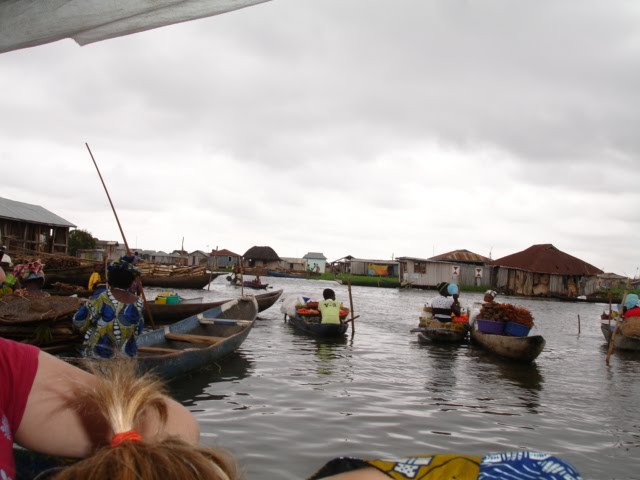
The village of Ganvie, one of the three stilt villages outside of Cotonou in the middle of a large shallow lake named Lake Nokoue. According to Wikipedia the village has 20,000 inhabitants. To travel within the village, villagers take their pirogues (traditional canoes). The coolest thing about this is the marche, where women row their pirogues to a central area with their boats full of fish, tomatoes, onions and piment. Villagers then row their boats up to the edges of the market and barter with the floating marche mamas for goods.
Maybe about seven kilometers from land
Subscribe to:
Posts (Atom)